
People and scheduling
- Doctor and support-staff scheduling around real appointment demand
- Hiring, onboarding and role clarity for technicians and front desk
- Payroll administration, time tracking and time-off coordination
Practice management guide
Scheduling, staffing, inventory, payroll and reporting are one connected system. This guide covers what the practice manager role carries, the numbers worth reviewing monthly, and how operations connect to veterinary accounting and tax.
Speak directly with a veterinary tax specialist about your income, structure and next steps.
What good management looks like
Not a software choice and not a job title. A set of habits that keep the clinic's operations and its numbers describing the same reality.
Scheduling, staffing and inventory decisions show up in the financials within weeks. Managing one without visibility into the other is how practices grow busier without growing better off.
A short monthly look at revenue, payroll share, inventory cost and cash position turns the year into something you can steer instead of something you find out about in April.
Paying the owner from what happens to be left over obscures whether the practice is actually profitable — and weakens the payroll and tax-election work that depends on it.
Business accounts, business cards and captured receipts turn practice management data into records that support real positions rather than estimates.
A manager without access to clear, current numbers is making judgment calls in the dark. Reporting built for the role is part of the infrastructure, not a luxury.
Once operations and books are steady, tax planning becomes proactive — the fifth component of the Veterinary Business Foundation™, and the payoff for the four before it.
The practice manager role
In larger clinics this is a dedicated role. In smaller and mobile practices the owner usually carries it alongside a full caseload — which is exactly why the reporting has to be simple enough to actually use.
Management meets accounting
Management produces the activity. Veterinary accounting records it accurately, and proactive tax planning uses it. When those hand-offs are clean, decisions stop being guesses.
A practice can be well run day to day and still lose money it never needed to lose — because the entity was never revisited, owner pay has no documented basis, or the books are reconstructed once a year instead of maintained. Those are not management failures. They sit on the accounting and structure side of the line.
The practical test is simple: can you answer what the practice earned last month, what it cost to staff, and what is owed in tax before the year closes? If not, the constraint is usually visibility rather than effort.
Free download
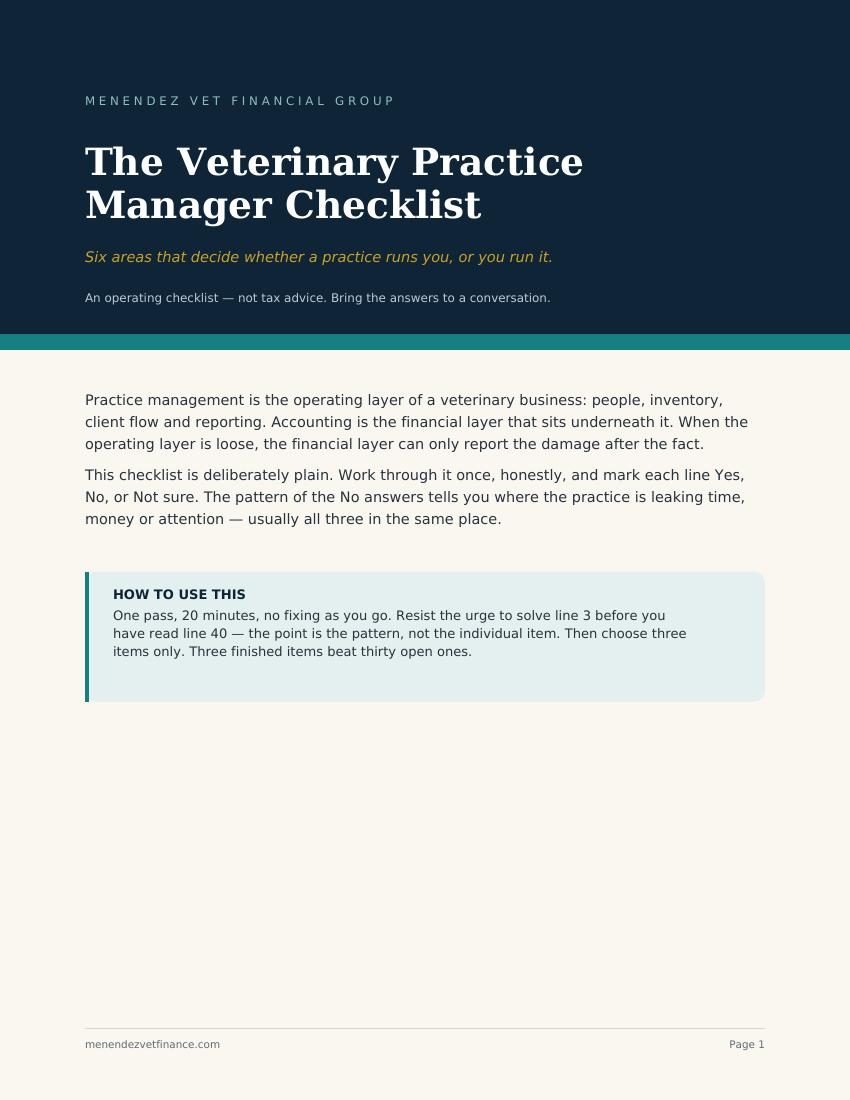
A four-page printable checklist covering the six areas that decide whether a practice runs you or you run it. Forty-plus lines, each marked Yes, No or Not sure — then a short method for turning the No answers into three decisions instead of thirty open tabs.
We ask for your details once. No cost, no obligation, unsubscribe any time.
Inside the PDF
Educational only. Not tax, legal or accounting advice, and it does not create a client relationship.
Common questions
Information on this website is general in nature and is not tax, legal or financial advice for any specific situation. Whether an entity, tax election, payroll arrangement or planning strategy is appropriate depends on individual circumstances and applicable requirements, and is determined only after reviewing your situation.
Keep reading
Next step
Speak directly with a veterinary tax specialist about your income, structure and next steps.